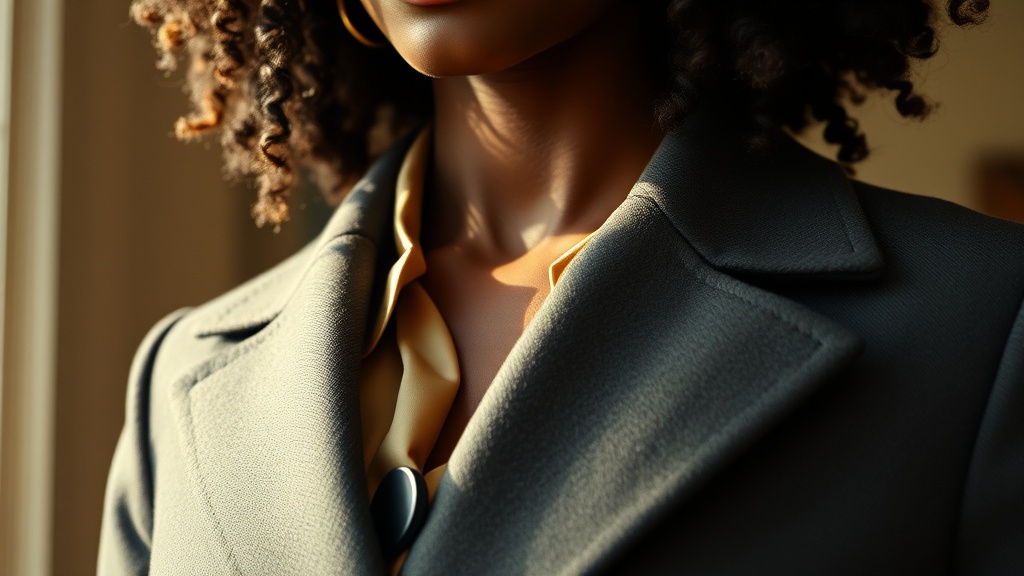
The Most Feminist Outfit in My Closet Cost $14
Every year around March 8th, brands post the same thing. Floral graphics. "Empowered women empower women." A limited-edition pink version of something that costs $200.
I'm not doing that.
Instead I want to talk about something that actually changed my life — and it has nothing to do with a girl boss aesthetic or a $180 "investment piece."
The Thing Nobody Told Me at Nordstrom Rack
I've been a visual merchandiser for three years. My job — literally my job — is to make a discount retailer look like it deserves your money. I know how to fold a stack of sweaters so the color gradient makes you want to touch them. I know where to hang the $89 blazer so it reads as $200. I know that the mannequin is wearing the same pants that were marked down twice, and she still looks like she's going somewhere important.
I learned all of that at work. Then I drove home in my 2019 Civic with the cracked windshield and applied every single one of those skills to my $30 thrift haul.
(The irony is not lost on me. I'm very aware.)
Here's what they don't train you on in visual merchandising: the skill works in reverse. If you know how clothing is presented to make it look expensive, you can find the exact same quality at a thrift store and present it on your body the same way. The clothes don't know they cost $14. They just sit there. What you do with them is the skill.
That's what Budget Style actually is. Not "here's how to be broke but cute." It's: here's how to read a garment the way a professional does, and why — in my opinion — a $14 thrifted blazer with real structure and a lining is a better investment than a fast-fashion one at $70 that pills after six washes.
What I Actually Look For (The Visual Merchandiser's Thrift Checklist)
Since IWD is Sunday and I want to give you something you can use this weekend:
When I walk into a Goodwill or an estate sale, I'm scanning for four things: (And if you want the full system behind how I hit the thrift stores, here's my exact Goodwill strategy.)
1. Structure in the shoulders. A blazer that holds its shape without a body inside it is built on real interfacing. That's a quality tell. Limp shoulders = cheap construction, regardless of the price tag.
2. Natural fabrics that have aged well. Wool, cotton, linen, silk. These things last. I can spot a silk blouse from ten feet away by how it moves under fluorescent lights. Fast fashion doesn't move like that. It just hangs.
3. A lined interior on anything structured. Unlined blazers are a shortcut. Real tailoring has a lining. You're looking for that slippery interior fabric that makes it feel finished.
4. Buttons that match the garment's weight. Cheap buttons get swapped out by manufacturers trying to save pennies. If a jacket has heavy, matte buttons and substantial fabric, it was made by someone who cared about the whole garment. If the buttons feel like they came from a random bin, the rest of the construction probably didn't get more attention.
I found a cashmere-blend turtleneck last month using exactly this checklist. The tag said Vince. I paid $8. I pulled up the brand's site in the aisle — that style was sitting at $195. To me, that's not luck. That's a trained eye.
Financial Autonomy Is the IWD Story Nobody's Telling
Here's what International Women's Day means to me in 2026, specifically:
It means I don't wait for someone to buy me nice things. I don't wait for a promotion. I don't wait until I "deserve" to feel put-together. I don't budget my self-worth.
I grew up watching my mom work two jobs and still apologize for not being able to buy us new things. She'd internalized this idea that good things were for other people — people who'd earned it through some combination of income and worthiness she was always just short of. That thought pattern is real, and it follows you.
I spent most of my teenage years trying to outrun that feeling. Then something happened: I got genuinely good at thrifting. And getting good at it — really knowing what to look for, training my eye, learning the difference between real wool and acrylic by feel — made me realize I wasn't settling for less. I was winning at a game most people don't know exists.
Nobody can tell me I didn't earn the cashmere turtleneck. I put in the skill to find it. I know what I'm looking at. And I kept $187 in my account that month that I would have handed to a brand whose markup I'm not interested in funding.
That's the feminist act to me. Not buying the pink-edition anything. Not waiting until I feel worthy of nice clothes. Deciding that my skills are worth more than my spending — and walking into a room wearing proof of that.
Your IWD Challenge (For Real Though)
This week — before Sunday — I want you to find one thrifted piece that makes you feel powerful.
Not a project piece. Not "I'll alter this eventually." One thing you can wear right now that makes you feel like you showed up.
Here's how to approach it with the checklist above:
- Start in the blazers. They're the highest-impact, lowest-effort piece. One blazer makes any outfit look intentional.
- Feel the fabric before you look at the size. If it's got weight and drape, that's your signal. You can always size up and have it tailored; you can't add quality to something cheap.
- Check the lining. Turn it inside out in the aisle. I don't care if people look at you.
- Try it on and ask one question: Does this look like it cost money? If yes, that's your answer.
Budget for this: $8–$20. That's the range. Anything above $25 at a thrift store better have a designer tag worth researching on your phone before you buy.
When you find it: wear it Sunday. Take a photo. Post it. Tag Budget Style.
Not because I need the engagement (I mean, I'll take it, obviously). Because you should document the moment you started choosing your own style instead of waiting for permission to afford it.
That's what this day means to me. Not a brand campaign. Not "celebrate women by spending money on women's brands" circular logic.
A $14 blazer that fits right. Found by knowing what to look for. Worn into a room like I owned the place.
(Because I did. Obviously.)
You've got this. Now go find something that makes you feel like money.
— Keisha
You might also enjoy
How Thrifting Made Me Stop Apologizing for My Budget — The deeper story behind financial autonomy and generational wealth patterns in how we dress.