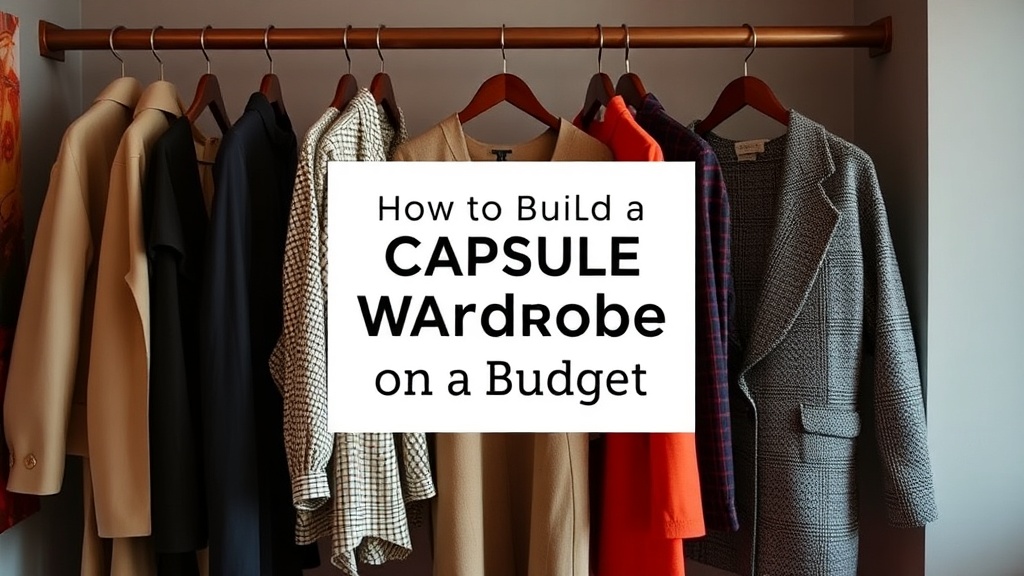
How to Build a Capsule Wardrobe on a Budget

A capsule wardrobe delivers maximum outfit options with minimal pieces — typically 25 to 40 items that work together seamlessly. This guide breaks down exactly how to build one without draining savings, from selecting foundational pieces to shopping smart at thrift stores and sales racks. You'll learn specific brands that balance quality and price, formulas for mixing and matching, and common mistakes that blow budgets fast.
What Is a Capsule Wardrobe (And Why Does It Save Money)?
A capsule wardrobe is a curated collection of clothing where every item coordinates. Think neutral bases — black, navy, cream, gray — plus a few accent colors, all in fabrics and cuts that layer well together.
Here's the math that makes this approach work: owning 30 pieces that all complement each other creates over 1,000 possible outfit combinations. Compare that to a closet stuffed with 100 random items that only match in small clusters. The capsule approach eliminates "I have nothing to wear" syndrome while cutting clothing spending by 40% or more annually.
The concept dates back to 1970s London boutique owner Susie Faux, but it gained mainstream traction through Project 333 — wearing only 33 items for three months. You don't need to be that extreme. A functional budget capsule simply means every purchase earns its place through versatility.
Worth noting: this isn't about dressing boring. It's about dressing smarter. A $25 navy blazer from H&M gets more wear than a $200 statement coat that matches nothing.
How Many Pieces Do You Actually Need for a Complete Capsule?
Most functional capsules contain 32 to 37 pieces total, including shoes but excluding accessories, workout gear, and special occasion wear.
That number sounds small. It isn't — when selected correctly, these pieces replace 80% of what most people actually wear. The secret lies in the 70/30 rule: 70% foundational basics, 30% personality pieces.
Here's a breakdown that works for real life:
| Category | Quantity | Examples |
|---|---|---|
| Tops | 8-10 | White button-down, striped tee, black turtleneck, silk cami |
| Bottoms | 6-8 | Dark wash jeans, black trousers, midi skirt, tailored shorts |
| Dresses | 2-4 | Little black dress, shirt dress, wrap dress |
| Layers | 4-5 | Denim jacket, camel coat, navy blazer, cardigan |
| Shoes | 6-8 | White sneakers, ankle boots, loafers, nude heels |
| Total | 32-37 | — |
The catch? These numbers assume everything coordinates. Ten tops that only match one specific bottom won't work. Build around a cohesive color palette from day one.
Where Should You Shop for Quality Pieces Under $50?
Certain retailers consistently deliver construction and fabric quality that outlasts fast fashion's typical six-month lifespan — without requiring full-price department store budgets.
For bottoms and structured pieces, Uniqlo remains unmatched in the under-$50 category. Their Ultra Light Down jackets ($39.90), cotton Oxford shirts ($29.90), and Smart Ankle Pants ($39.90) use fabrication that rivals brands charging triple. The sizing runs consistent, which matters when ordering online.
Nordstrom Rack (yes, where this advice comes from firsthand experience) offers past-season merchandise from Nordstrom proper at 40-65% off. Look for the "Clearance" racks marked with red tags — these take an additional 25-40% off the already-reduced price. Current finds include Kut from the Kloth jeans for $34 and Vince Camuto blazers for $49.
For basics that don't pill after three washes, Everlane's "Choose What You Pay" section offers organic cotton tees for $12-16. Their transparency about factory costs helps you understand where money actually goes.
Thrift stores in affluent neighborhoods yield designer pieces at fraction prices. The Goodwill in wealthy suburbs often receives barely-worn Theory blazers, J.Crew cashmere, and Cole Haan shoes. Go Tuesday through Thursday — weekend crowds pick over the best stock.
Worth noting: Amazon's The Drop features limited-edition collections from influencers, with pieces typically $30-60. Quality varies by designer, but the customer reviews help you spot winners.
Brands to Avoid (Even on Sale)
Some budget retailers use fabric blends that stretch, pill, or fade within weeks. Skip anything with more than 5% elastane in pants — that "comfort stretch" becomes baggy knees within hours. Avoid viscose tops that require dry cleaning; they shrink unpredictably and wrinkle instantly.
Shein, Temu, and ultra-fast fashion retailers tempt with $8 price points. The environmental cost aside (which matters), the per-wear cost usually exceeds buying one quality piece. A $12 skirt that lasts three wears costs $4 per wear. A $45 skirt that lasts three years costs pennies.
What Colors Should Form Your Capsule Foundation?
Neutrals anchor everything. They blend seamlessly, hide wear better, and read as more expensive than bright colors (even at the same price point).
Start with this core palette:
- Deep navy — softer than black, equally slimming, more versatile
- Charcoal gray — the bridge color that connects black and navy pieces
- Cream or off-white — warmer than stark white, less prone to yellowing
- Taupe or camel — adds warmth without competing for attention
- Black — for shoes, belts, and pieces where you want maximum impact
Add two accent colors maximum. Burgundy and forest green work across seasons. Dusty rose and mustard yellow suit warmer complexions. Powder blue and soft gray flatter cooler tones.
Here's the thing about patterns: they limit versatility. One striped Breton top adds French flair. Five striped tops create a costume. Choose patterns strategically — one animal print accessory, one plaid scarf, one floral dress. Everything else stays solid.
How Do You Build Outfits From Limited Pieces?
The outfit formula system eliminates morning decision fatigue. Instead of staring at the closet hoping for inspiration, you apply templates.
Master these five formulas and you've covered work, weekends, dates, and everything between:
- Formula A: Fitted top + structured bottom + third layer (blazer/cardigan) + interesting shoe
- Formula B: Oversized sweater + slim pants + ankle boots
- Formula C: Button-down shirt + jeans + blazer + loafers or heels
- Formula D: Dress + third layer + shoe that changes the vibe (sneakers casual, boots edgy, heels polished)
- Formula E: Monochrome base + contrasting shoe + statement accessory
The "third layer" concept deserves emphasis. A simple jeans-and-tee combo becomes an outfit with a blazer thrown over. That same blazer over a dress creates a completely different look. Layers do the heavy lifting in capsules.
Accessories multiply options without multiplying piece count. One quality leather belt (Fossil makes excellent options around $40) pulls together oversized pieces. A silk scarf tied at the neck, wrist, or bag handle adds color without requiring a new top. Gold hoop earrings — the Mejuri mini hoops at $58 or similar from Target's A New Day line at $12 — work with everything.
What's the Smartest Way to Phase Into a Capsule Wardrobe?
Don't purge everything and start fresh. That's expensive and overwhelming.
Instead, try the reverse hanger method. Turn every clothing item backward on its hanger. As you wear pieces, return them facing forward. After three months, anything still backward goes into storage boxes. What you actually wore becomes your capsule foundation — now you know your true preferences, not your aspirational ones.
Phase two: identify gaps. You wore those black trousers ten times but only own one top that looks right with them. That's your shopping list. Not "more tops" — "one cream silk blouse to pair with black trousers."
Set a monthly budget — $75 to $150 works for most people — and buy only list items. Wait for sales. Sign up for thredUP notifications when specific brands (J.Crew, Madewell, Ann Taylor) get new inventory. Use Rakuten for cashback on online orders.
The one-in-one-out rule maintains your capsule long-term. New sweater arrives? One sweater leaves. Donate, sell on Poshmark, or host a clothing swap with friends. Physical closet limits create mental clarity.
"Buy less, choose well, make it last." — Vivienne Westwood
Common Budget Capsule Mistakes
Even seasoned shoppers slip up. Watch for these pitfalls:
- Buying duplicates. You don't need three black cardigans. One excellent one beats three mediocre ones.
- Ignoring fit. A $200 blazer that needs tailoring looks worse than a $40 blazer that fits perfectly. Budget $10-20 per piece for alterations.
- Chasing trends. That corset top looks great on Instagram influencers. Will it work with your existing pieces? Probably not.
- Forgetting shoes. Scuffed, worn-out footwear ruins expensive-looking outfits. Shoe care — polish, heel taps, sole protectors — extends life dramatically.
Building a capsule wardrobe on a budget requires patience more than money. The woman who spends six months curating 35 perfect pieces ends up better dressed than the one who panic-buys a new wardrobe every season. Start with what you own. Add strategically. Choose pieces that feel like you — just the most polished, pulled-together version.
Steps
- 1
Audit Your Current Closet and Define Your Style
- 2
Create a Shopping List of Essential Pieces
- 3
Shop Smart: Thrifting, Sales, and Quality Investment