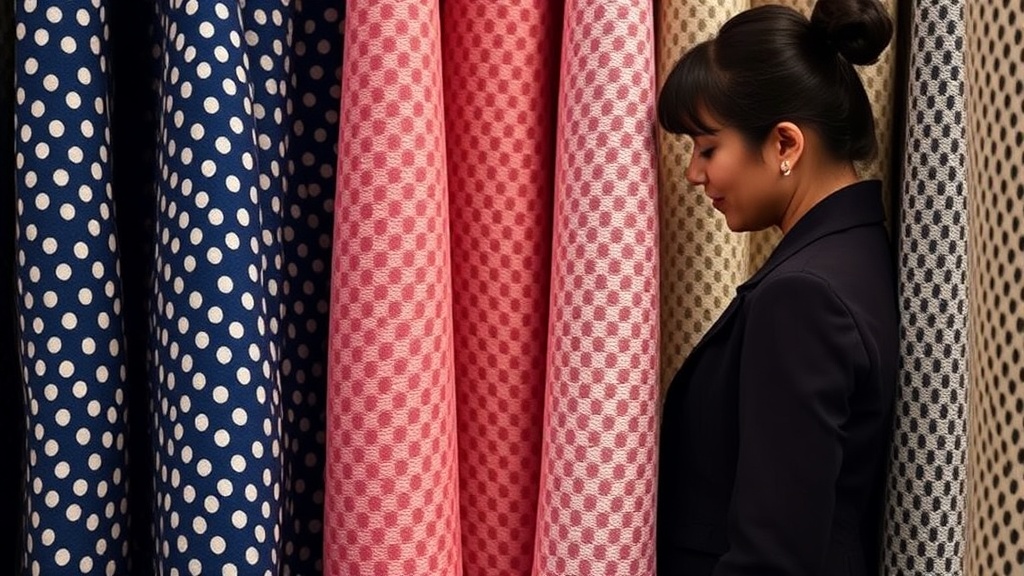
Can You Spot Quality Fabrics Just by Looking? A Visual Buyer's Guide

You Can't Judge Fabric by Price Tag Alone
There's a persistent myth in fashion circles that expensive equals quality—that a $300 blouse must be better than a $30 one simply because of the number on the tag. After years of visual merchandising at Nordstrom Rack and hunting down hidden gems for Budget Style, I can tell you that's simply not true. Some of the most luxurious-looking pieces in my wardrobe came from discount racks and thrift bins. The difference isn't what you spend—it's knowing what to look for. This guide teaches you to spot quality fabrics visually, so you can walk into any store (or scroll any site) with the confidence of a seasoned buyer.
What Makes Fabric Look Expensive From Across the Room?
Before you even touch a garment, your eyes are already gathering information. High-end fabrics share visual characteristics that signal quality to our subconscious—and understanding these signals lets you hack the perception of luxury without hacking your budget.
Drape tells the whole story. Quality fabrics fall in soft, fluid lines. They don't stick out at weird angles or hold rigid shapes that fight against gravity. When you see a dress or blouse hanging on a rack, notice how the hemline falls. Does it create a natural, graceful silhouette? Or does it jut out like cardboard? Natural fibers—cotton, silk, wool, linen—and quality synthetics designed to mimic them share this graceful drape that cheaper materials struggle to replicate.
Sheen and surface texture matter enormously. Cheap fabrics often have an artificial, plastic-like shine that catches light uniformly across the surface. Quality materials have more nuanced light reflection—matte finishes that absorb light elegantly, or subtle lusters that shift as you move. Look for depth in the fabric's surface. Does it look like it has dimension, or does it appear flat and one-note?
Weight signals substance. This one's tricky online, but in person, quality fabrics have presence. They don't flutter at the slightest breeze or cling desperately to the hanger. A heavyweight cotton poplin, a substantial crepe, a dense wool blend—these materials look expensive because they feel expensive, and that visual heft translates even through photos.
Can You Identify Natural vs. Synthetic Fibers Visually?
Here's where your inner fabric detective gets to work. You don't need a microscope—just attention to detail and a few telltale signs.
Linen and cotton show slight irregularities in the weave. Look closely (or zoom in on product photos) and you'll see natural variation in the threads. This isn't a flaw—it's a fingerprint of authenticity. Synthetic imitations often look too perfect, too uniform. Real linen wrinkles beautifully; it doesn't crease in stiff, angular lines but in soft, organic folds.
Silk and silk-alternatives create distinctive light play. Genuine silk has a subtle luminosity—what experts call "luster" rather than shine. It glows rather than glares. Quality satin weaves (even polyester ones) mimic this by creating smooth surfaces where light slides across rather than bouncing back harshly. When shopping online, look for product photos that show the fabric in motion—silk and quality alternatives ripple like water.
Wool and wool-blends present visual depth through texture. Even smooth woolens have a slight fuzz or halo that catches light softly. Cheap synthetic knits often look either too sleek and plastic-y or too fuzzy in an artificial way. Look for wool coats and sweaters with what textile experts call "fiber cohesion"—the surface looks unified rather than pilly or scattered.
For a deeper dive into textile identification, the Textile Society of America offers excellent resources on fiber properties and visual characteristics.
Which Fabric Red Flags Should Make You Walk Away?
Just as important as knowing what to seek is knowing what to avoid. These visual warning signs scream "cheap"—and not in the good, budget-friendly way.
Prints that don't penetrate the fabric. Hold the material up to light (or check if product photos show the reverse side). Quality printed fabrics show the pattern clearly on the back. Cheap printing sits on the surface like a sticker, often cracking or peeling after a few washes.
Visible weave distortion. Look at the grain of the fabric—the direction the threads run. Quality materials maintain consistent tension; the weave looks orderly and even. Cheap fabrics often show pulling, stretching, or wavy lines where the construction couldn't hold shape properly.
Trim that doesn't match. Check the inside seams, the hem facings, the lining if there is one. Budget brands trying to fake luxury often cheap out on these hidden elements. If the outer fabric looks decent but the lining is thin and shiny, or the seams are finished with overlocked raw edges rather than clean bindings, you're looking at corners being cut.
Color that looks "off." Cheap dye jobs result in muddy, uneven, or strangely harsh colors. Quality fabrics—even in bold shades—have depth and clarity. A red looks rich rather than screechy. A navy has complexity rather than looking like someone mixed all the paints together. Trust your instincts here; if a color feels wrong, it probably is.
How Do Online Photos Reveal Fabric Quality?
Shopping online removes the tactile element, but visual cues become even more important. Here's how to read between the pixels.
Zoom in aggressively. Most e-commerce sites allow magnification. Use it. Look at the fabric texture up close. Can you see individual threads? Is there variation in the weave? Or does it look like a flat, printed texture? Real fabric has dimension.
Study how the garment hangs on the model. Professional photography can hide flaws, but it can't fake physics. Notice whether the fabric flows naturally with movement or seems to hold stiff, artificial shapes. Check if it wrinkles authentically at joints (elbows, knees) or looks artificially pressed into place.
Look for multiple angles and detail shots. Brands proud of their fabric quality show it off. They include close-ups of texture, photos of the interior construction, shots that capture drape and movement. If a listing only shows flat lay photos or heavily filtered images, that's a red flag.
Read the fiber content carefully. This isn't visual, but it's key. A "polyester" dress tells you less than a "polyester with mechanical stretch and brushed back." The latter indicates intentional engineering to create specific hand-feel and drape. For guidance on interpreting fiber content labels, the FTC's Textile Fiber Products Identification Act provides official definitions and labeling requirements.
The Texture Hierarchy: What to Prioritize
Not all budget fabrics are created equal. If you're building a wardrobe that looks expensive, prioritize materials in this order:
- Top tier: Silk, wool, cashmere, linen, high-quality cotton (pima, Egyptian, organic)
- Excellent alternatives: Tencel/lyocell, modal, viscose when heavyweight, quality polyester crepe
- Acceptable with caveats: Standard polyester, rayon, acrylic blends—look for substantial weight and good construction
- Avoid if possible: Thin, shiny polyester; cheap acrylic that pills immediately; fabrics with obvious chemical smells
Can You Make Inexpensive Fabrics Look Luxurious?
Absolutely. Some of my most-complimented pieces cost under $25. The secret isn't the fabric alone—it's how you treat and style it.
Steam everything. Cheap fabrics often look expensive after a good steaming. The heat relaxes fibers, smooths out manufacturing creases, and restores drape. A handheld steamer is a $20 investment that makes every garment in your closet look triple its price.
Pay attention to fit. A $15 dress that fits perfectly looks more expensive than a $500 dress that hangs wrong. Budget fabrics often lack the finishing touches (interfacing, proper lining) that help garments hold shape. Taking pieces to a tailor for minor adjustments—taking in a waist, shortening sleeves—transforms how the fabric falls on your body.
Layer strategically. Thin, potentially revealing fabrics gain instant credibility when layered over quality basics. That slightly-sheer polyester blouse? Layer it over a substantial cotton camisole. The cheap-feeling dress? Add a structured denim jacket or wool cardigan that provides textural contrast.
Invest in care. Wash delicate fabrics on gentle cycles, air dry when possible, and store properly. Even inexpensive materials maintain their visual appeal longer with basic TLC. The American Cleaning Institute offers detailed guidance on fabric care that extends garment life significantly.
"The most expensive-looking outfit I own—a cream silk blouse and tailored trousers—cost $38 total. The blouse was $12 at a thrift store, the trousers $26 on clearance. Both pieces share substantial fabric weight, natural fiber content, and excellent drape. When I wear them, people ask which designer I bought them from."
Your eyes are more powerful than you think. Train them to see fabric the way a visual merchandiser does—not as a price tag, but as a collection of physical properties that create visual impact. Walk into any store with these skills, and you'll start spotting the $30 pieces that look like $300. That's not just shopping smart. That's the Budget Style way.